
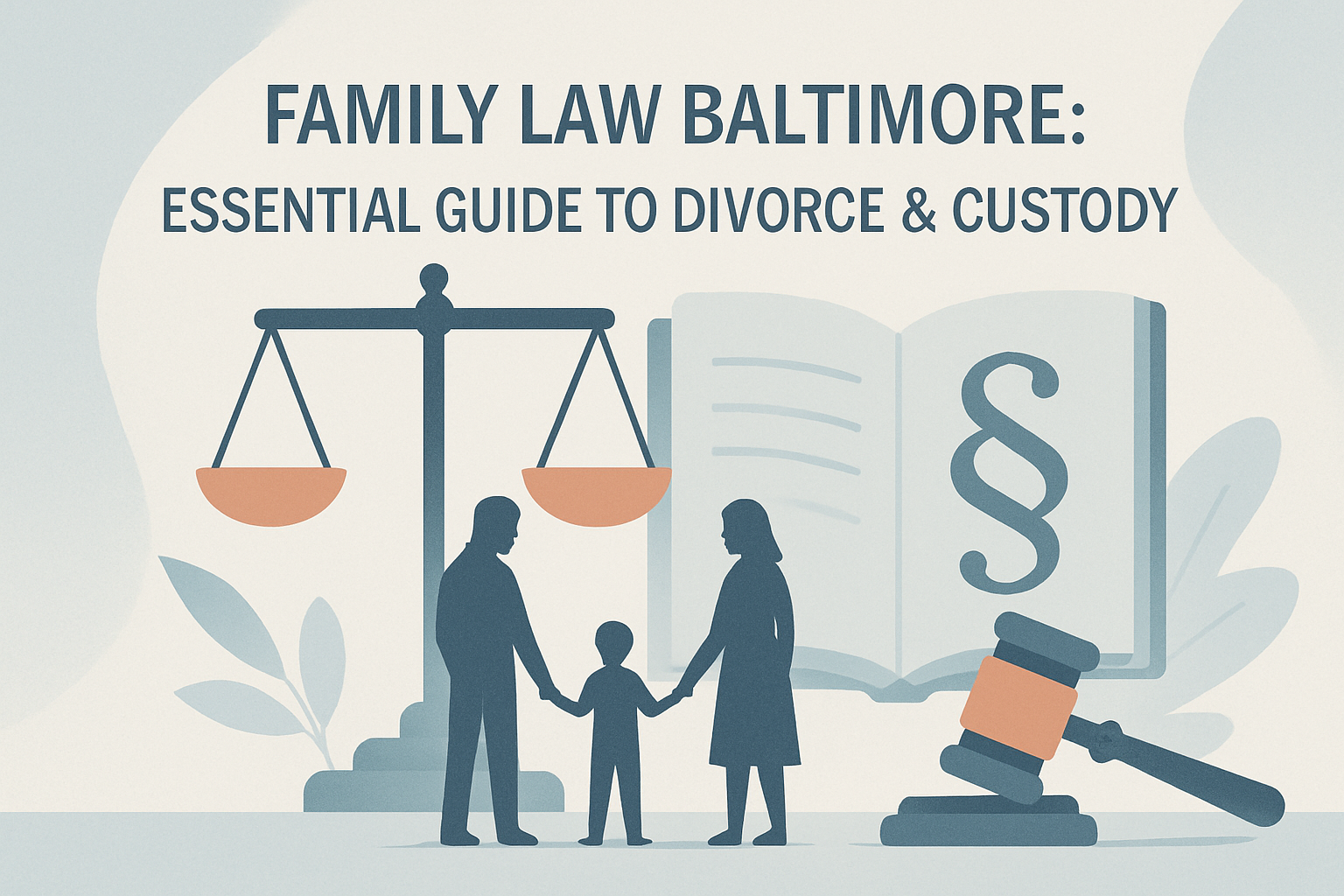
Family Law Baltimore: Essential Guide to Divorce & Custody
Introduction
family law baltimore: in Baltimore, family law covers divorce, child custody, child support, spousal support, property division, and protective orders. Knowing where to start affects outcomes and timing. This guide explains how local family law attorneys work, how Baltimore courts usually handle these issues, and what you can prepare to protect your interests. Here’s what we cover: services Baltimore family law lawyers provide; choosing counsel and questions to ask at your first consult; filing differences between Baltimore City and Baltimore County; custody and support basics; property division strategy; protective orders and alternatives to litigation; and clear next steps you can take before and after a consultation.
What “family law baltimore” means — services Baltimore family law attorneys provide
Family law attorneys in Baltimore handle a wide range of matters that affect families’ legal and financial futures. Typical services include divorce (contested and uncontested), child custody and parenting plans, child support, spousal support, property division under Maryland’s equitable distribution rules, and protective orders for domestic violence situations. Local counsel also manages procedural steps—filings, discovery, hearings—and helps clients decide when mediation, negotiation, or litigation is appropriate. When cases involve complex assets, attorneys coordinate with forensic accountants, valuation experts, and tax advisors.
For authoritative local procedure and self-help resources, see the Maryland Courts family law pages: https://www.mdcourts.gov/family. For child support program information, the Maryland Department of Human Services offers practical guidance at DHS Child Support Services.
How to choose a family law attorney in Baltimore (questions to ask at the consult)
Choosing the right attorney starts with focused questions at the initial consultation. Ask about experience with cases like yours, the lawyer’s typical approach to settlement versus trial, communication preferences, billing structure, and the likely next steps. Request references or sample case strategies and ask how the attorney would build a staged plan for custody, support, or complex asset division so you can evaluate fit and likely outcomes.
Experience with financial and high-asset cases
Ask whether the attorney has handled high-asset divorces, business valuations, retirement account division, and complex financial disclosures. An attorney who regularly works with forensic accountants and valuation experts can better identify leverage points and protect tax and liquidity interests during settlement talks.
Client communication, fees, and retainer structure
Discuss the fee model clearly—hourly, blended, or fixed-fee for defined tasks—and ask how litigation costs are billed versus negotiation. Clarify retainer replenishment practices and how often you will receive statements so there are no billing surprises. If budget is a concern, ask about limited-scope representation for specific tasks.
Strategy, alternatives, and staged planning
Good counsel outlines a staged plan—what to do first (financial disclosure, temporary orders), mid-game goals (parenting plan, valuation, settlement structure), and endgame options (trial or resolution). A clear plan shows checkpoints where settlement is likely and where litigation becomes necessary.
Divorce in Baltimore: filing basics, contested vs uncontested cases
Filing a divorce in Baltimore begins with deciding whether the case will be uncontested (both parties agree on the core issues) or contested (disputes require court intervention). An uncontested case focuses on exchanging documents and preparing a settlement agreement for the court. A contested case involves pleadings, discovery, temporary relief hearings, and possibly a trial. Your attorney will gather financial disclosures, seek temporary orders as needed, and advise on timing based on assets and custody complexity.
Uncontested divorce path and efficient settlement
When both sides agree, the process centers on drafting a comprehensive settlement agreement that addresses children, support, property allocation, and debts, then submitting it for court approval. The lawyer ensures terms are enforceable and reflect your goals before final judgment.
Contested divorce path and managing litigation
Contested cases follow a sequence—initial filings, discovery, temporary hearings, settlement negotiations, and trial preparation. An experienced attorney prioritizes temporary issues, uses discovery to collect necessary documentation, and identifies realistic settlement leverage to avoid unnecessary expense and delay.
Common timelines and practical planning
Every divorce varies with complexity. Cases with modest assets and agreement resolve faster than high-asset or hotly contested custody disputes. Efficient planning focuses on staged goals—temporary orders first, targeted discovery, then mediation—so resources are spent where they change the outcome most.
Child custody & parenting plans — how Baltimore courts decide custody
Custody decisions in Baltimore are guided by the child’s best interests. Courts evaluate factors such as the child’s relationship with each parent, each parent’s ability to meet the child’s needs, the stability of the child’s home environment, and any history of abuse or neglect. A practical parenting plan should address decision-making authority, residential schedules, holidays, school arrangements, and dispute-resolution steps so a judge can approve a plan that supports the child’s stability.
Best-interests factors judges may consider
Courts weigh multiple factors—parental fitness, the child’s needs, continuity of care, and safety. Your attorney will document evidence, propose a parenting plan tailored to those factors, and show how the plan supports the child’s routine and long-term welfare.
Drafting a workable parenting plan
A strong parenting plan balances clarity and flexibility: specify residential time, communication expectations, decision-making authority, transportation responsibilities, and procedures for making changes. Include dispute-resolution steps such as mediation to reduce court returns and protect the child’s routine.
Modification and enforcement of custody orders
Custody orders can be revisited when circumstances change materially—relocation, parental conduct changes, or the child’s needs. An attorney explains how to seek modifications or enforce orders, typically starting with documentation of the change and using negotiation, motion practice, or contempt procedures when needed.
Child support in Maryland: calculation, enforcement, and modifications
Child support in Maryland uses statutory guidelines that account for both parents’ incomes and the child’s needs, though courts may deviate in special circumstances. Attorneys help assemble accurate income documentation, propose guideline-based support numbers, and advise on enforcement tools and modification options when incomes or needs change.
Financial disclosure and establishing income
Accurate financial disclosure is essential. Expect requests for pay stubs, tax returns, business records, and benefit statements. Self-employment, bonuses, and non-wage income can alter support calculations, so your attorney will explain how those items are treated and documented.
Enforcement tools commonly used
When support is unpaid, enforcement options include income withholding, contempt motions, and administrative remedies. Counsel evaluates the most effective approach to restore payments while protecting parental rights and the child’s support stream.
Seeking modification when circumstances change
Support orders may be modified for a material change in circumstances—income shifts, job loss, or changes in the child’s needs. An attorney documents the change, proposes a revised calculation, and files a motion or negotiates a stipulated modification when appropriate.
Spousal support (alimony) — what Baltimore judges consider
Spousal support decisions typically consider the duration of the marriage, each spouse’s financial condition and earning capacity, contributions to the marriage (including caregiving and education), and the payor’s ability to pay while meeting their own needs. Lawyers evaluate whether temporary, rehabilitative, or long-term support fits the facts and craft arguments and evidence to support or oppose an award as part of settlement strategy.
Property division: equitable distribution in Maryland and common disputes
Property division follows equitable distribution, which means marital property is divided fairly, though not always equally. Attorneys help identify marital versus non-marital assets, arrange valuations for businesses and retirement accounts, trace commingled funds, and negotiate settlements that consider tax consequences and liquidity needs while anticipating the client’s post-divorce finances.
For example, choosing between keeping the family home or taking liquid assets requires analyzing tax cost, mortgage responsibility, and long-term housing needs. Your attorney will model outcomes so you can make an informed choice.
Protective orders & domestic violence — emergency steps and local resources
If you face domestic violence, immediate steps include seeking a protective order through family court, documenting incidents, and working with law enforcement and support services. An attorney can file emergency petitions, obtain temporary protective measures, and coordinate safety planning while preserving legal remedies for custody, support, and property matters.
Local shelters and advocacy organizations can help with safety planning; your attorney should connect you with community resources and explain how protective orders interact with custody and criminal proceedings.
Mediation and alternatives to litigation — when to use them in Baltimore family cases
Alternatives like mediation or collaborative law often reduce cost, speed resolution, and allow tailored outcomes. Your attorney will assess whether negotiation fits the dispute—considering power imbalances, domestic violence history, and financial transparency—and can represent you in mediation or structure a parallel settlement process without giving up the option to litigate if talks fail.
For example, mediation works well when both parties are committed to exchange accurate financial information and want to preserve privacy and control over terms. When safety or severe information gaps exist, litigation or limited discovery may be necessary first.
Where to file: Baltimore City vs Baltimore County family court (what to expect at your first hearing)
Where you file depends on residence and the nature of the case. Baltimore City and Baltimore County have separate family divisions and local procedures. Your first hearing usually focuses on temporary matters—custody, temporary support, and scheduling discovery. An attorney prepares a clear packet for the court, requests appropriate temporary relief, and sets a timeline for discovery and settlement negotiations.
Ask your lawyer about local judge preferences and courtroom logistics; those practical details shape what evidence and temporary orders the court will consider at the first hearing.
How much does a family law attorney cost in Baltimore (hourly fees / retainers)?
Attorney fees vary with case complexity, lawyer experience, and whether litigation is required. Many attorneys charge hourly rates with an initial retainer; others offer fixed fees for discrete tasks such as drafting settlement agreements or handling uncontested matters. At a consult, request realistic budget ranges for likely scenarios and ask about phased billing and limited-scope options to manage costs.
How do I find a family law attorney in Baltimore?
Finding an attorney starts with clarity about your goals—privacy, speed, or maximum recovery—and using referrals, bar association directories, and consultations to compare experience and approach. Prioritize lawyers who present a staged plan, clear fee expectations, and familiarity with Baltimore City or County practices. If custody is central, ask about experience with parenting plans and local judges.
Start your search with local resources and interviews: contact the Maryland State Bar Association or use a trusted referral network. Consider a brief paid consult with two lawyers to compare strategies and budgets before deciding.
Can I get free or low-cost family law help in Baltimore?
There are low-cost options for qualifying clients, including nonprofit clinics, legal aid programs, and community organizations that provide limited-scope assistance or referrals. These services help with document preparation and basic guidance, but complex custody or high-asset matters usually require retained counsel who can build and execute a comprehensive strategy.
Common mistakes to avoid in Baltimore family law cases
Avoid predictable errors such as delaying financial organization, failing to document parenting time, negotiating major settlement points without legal advice, or assuming temporary orders will be permanent. Instead, assemble financial records early, track parenting time and shared expenses, and use an attorney to convert short-term wins into enforceable long-term terms.
Next steps: preparing for a consultation and building a plan
Prepare a consultation packet with recent pay stubs, tax returns, bank statements, a list of assets and debts, a parenting-time calendar, and a brief statement of your goals. That allows your attorney to propose a staged plan during the first meeting. Bring questions about timelines, likely expenses, and settlement-versus-litigation trade-offs so you leave the consult with a clear action list.
Consider using limited-scope representation for discrete items—drafting a parenting plan or preparing temporary orders—if you want to control costs while securing expert guidance.
family law baltimore — how Divorce With a Plan approaches cases with a clear strategy
Divorce handled the right way begins with a plan. At Divorce With a Plan we emphasize staged preparation: immediate priorities (safety, temporary orders, financial triage), mid-term steps (discovery, valuation, parenting plan drafting, mediation), and endgame decisions (settlement structuring or trial readiness). Our approach is pragmatic—tailoring negotiation or litigation strategies to each client’s objectives, communicating expected steps and likely costs, and coordinating necessary experts when cases involve complex assets or valuation issues.
If you want a Maryland-focused family law attorney who will build a clear, written strategy for your divorce, custody, or support matter, schedule a consultation through Contact Us to discuss your situation and shape a practical plan for the next steps. You can also review related resources on our site: Related Topic and Relevant Page.
Frequently Asked Questions
These are the questions Maryland families ask most often about this topic. Each answer is general information rather than advice about a specific case, and the right approach always depends on the details of your situation.
How do I find a family law attorney in Baltimore?
Start by clarifying your objectives—custody, high-asset division, or a quick uncontested divorce—then use referrals, consultations, and bar association resources. Ask about local experience, staged plans, fee expectations, and familiarity with Baltimore City or County courts to assess fit before hiring.
How much does a family law attorney cost in Baltimore (hourly fees / retainers)?
Fees vary with complexity, lawyer experience, and whether the matter goes to trial. Many attorneys charge hourly rates with an initial retainer and provide phased budgets. At consults, request realistic cost ranges for likely scenarios and options for limited-scope work.
What family law matters do Baltimore family law attorneys handle — custody, support, divorce?
Baltimore family law attorneys commonly handle divorce (contested and uncontested), child custody and parenting plans, child support, spousal support, property division, and protective orders, and they coordinate financial experts or mediators when cases require valuation or specialized negotiation.
Do I file my case in Baltimore City or Baltimore County family court?
Where you file depends on residency and the nature of the case; procedures differ between Baltimore City and Baltimore County. Consult an attorney early so filings, initial requests for temporary orders, and first hearing preparation reflect the correct local practice.
Can I get free or low-cost family law help in Baltimore?
Yes, nonprofit legal aid clinics and community programs offer low-cost or limited-scope assistance for eligible clients, which is helpful for document preparation and basic guidance, though complex or high-asset matters usually require retained counsel for strategy and advocacy.
This article is for general informational purposes only and does not constitute legal advice. Maryland law changes, and every situation is unique. Consult a qualified Maryland family law attorney about your specific circumstances.
Frequently asked questions
How do I find a family law attorney in Baltimore?
Start by clarifying your objectives—custody, high-asset division, or a quick uncontested divorce—then use referrals, consultations, and bar association resources. Ask about local experience, staged plans, fee expectations, and familiarity with Baltimore City or County courts to assess fit before hiring.
How much does a family law attorney cost in Baltimore (hourly fees / retainers)?
Fees vary with complexity, lawyer experience, and whether the matter goes to trial. Many attorneys charge hourly rates with an initial retainer and provide phased budgets. At consults, request realistic cost ranges for likely scenarios and options for limited-scope work.
What family law matters do Baltimore family law attorneys handle — custody, support, divorce?
Baltimore family law attorneys commonly handle divorce (contested and uncontested), child custody and parenting plans, child support, spousal support, property division, and protective orders. They coordinate financial experts or mediators when cases require valuation or specialized negotiation.
Do I file my case in Baltimore City or Baltimore County family court?
Where you file depends on residency and the case type. Procedures differ between Baltimore City and Baltimore County. Consult an attorney early so filings, initial requests for temporary orders, and first-hearing preparation match the correct local practice.
Can I get free or low-cost family law help in Baltimore?
Yes. Nonprofit legal aid clinics and community programs offer low-cost or limited-scope assistance for eligible clients, which is helpful for document preparation and basic guidance. Complex or high-asset matters generally require retained counsel for strategy and advocacy.